


Accountability: “Victim” or Responsible?

In recent years, more organizations have been emphasizing the value of responsibility or accountability. The concept appears in corporate values, leadership models and discussions around team performance. But what does it really mean in practice? Accountability is not simply about apologizing for our mistakes or taking responsibility for an outcome. It goes deeper than that: it is the conscious choice to stand by our commitments, recognize our role in what happens and act with awareness of the impact we have on others. Without it, even the best intentions often remain just words!
What you will find in this article:
-
- What we mean by accountability
- Factors that influence it
- How to cultivate a culture of accountability
A Definition and a Ladder
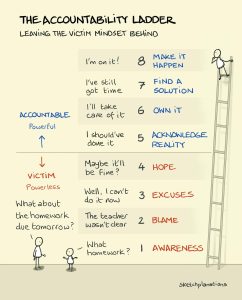
Roger Connors, Tom Smith, and Craig Hickman, in The Oz Principle: Getting Results Through Individual & Organizational Accountability, provide the following definition: Accountability is the personal choice to go above and beyond what is required and to take personal responsibility for achieving desired results. By introducing the term “personal choice,” it becomes clear that accountability is a subjective matter—it depends on how everyone chooses to act. To provide more objective indicators of what constitutes accountable behavior versus less or non-accountable behavior, Bruce Gordon offers valuable guidance. In 2007, he developed The Accountability Ladder, which distinguishes responsible behaviors from less responsible or non-accountable ones.
sketchplanations.accountability-ladder
On the four lower steps, we find non-accountable behaviors, also called victim behaviors:
- Denying e.g., “That can’t be happening—we’ve checked everything!”
- Blaming e.g., “It’s the other department’s fault for always delaying responses.”
- Excusing e.g., “I would have done it, but… I have too much on my plate / I wasn’t told what to do / no one showed me, etc.”
- Waiting and Hoping e.g., “Someone else will see it and take care of it.”
Moving up the ladder, we encounter accountable behaviors. From bottom to top:
- See it: Clearly observe the situation and acknowledge the issues as they are.
- Own it: Take personal responsibility for resolving the issue.
- Solve it: Identify practical ways to achieve the desired outcome.
- Do it: Take proactive steps and implement the solutions.
The ladder provides a simple way to distinguish accountable from less accountable behaviors. It gives us markers to observe whether a person -or even ourselves- is being accountable in a specific situation or overall. But what can undermine our accountability? Let’s explore…
Factors That Can Lower Us “Steps”
- In a team, communication is key. Ineffective communication, missing feedback, or unclear task instructions can undermine the development of accountability.
- Pressure for immediate results and a strong focus on KPIs often lead to a decline in collective accountability.
- Team fragmentation due to remote work can make engagement and communication more difficult, negatively affecting accountability.
- Finally, in work environments where roles are unclear, confusion arises, commitment decreases, and accountability is impacted.
Cultivating Accountability
Accountability is not just a matter of processes, but of culture and behavior. In an environment where a culture of accountability is fostered, individuals are more likely to stay higher on the accountability ladder. Those in leadership positions carry a greater share of responsibility in cultivating and sustaining this culture. Individuals in leadership positions bear a greater responsibility for fostering and sustaining this culture. As leaders, you can:
- Lead by example and guide your team on what responsible behavior looks like.
- Define clear roles and expectations for each team member.
- Provide precise instructions when assigning tasks and specify exactly what is expected as the deliverable (definition of done).
- Establish a systematic feedback process to ensure continuous communication and improvement.
- Recognize and reward accountable behaviors.
Cultivating accountability requires guidance, clarity, and continuous feedback. When supported by leadership, individuals remain higher on the accountability ladder, and the team operates more effectively.
Closing
If we recognize that we ourselves have moved across various steps—even exhibiting victim behaviors – it’s okay! Accountability is not simple, it requires ongoing effort and attention. We constantly move up and down the ladder, both personally and professionally. The key is to acknowledge it and strive more to reach the “top step”, because accountability is not just a skill – it’s a way of life.
Key Takeaways
Accountability is the personal choice to go above and beyond what is required and take personal responsibility for achieving desired results.
4 accountable behaviors: See it, Own it, Solve it, Do it.
Cultivating accountability requires guidance, clarity, and continuous feedback. When supported by leadership, individuals remain higher on the accountability ladder and the team functions more effectively.
At Game Tree, we offer learning experiences beyond the ordinary.
We design and implement customized training programs for corporate executives, leveraging experiential learning and educational gaming.
You can find more information about our services here.